

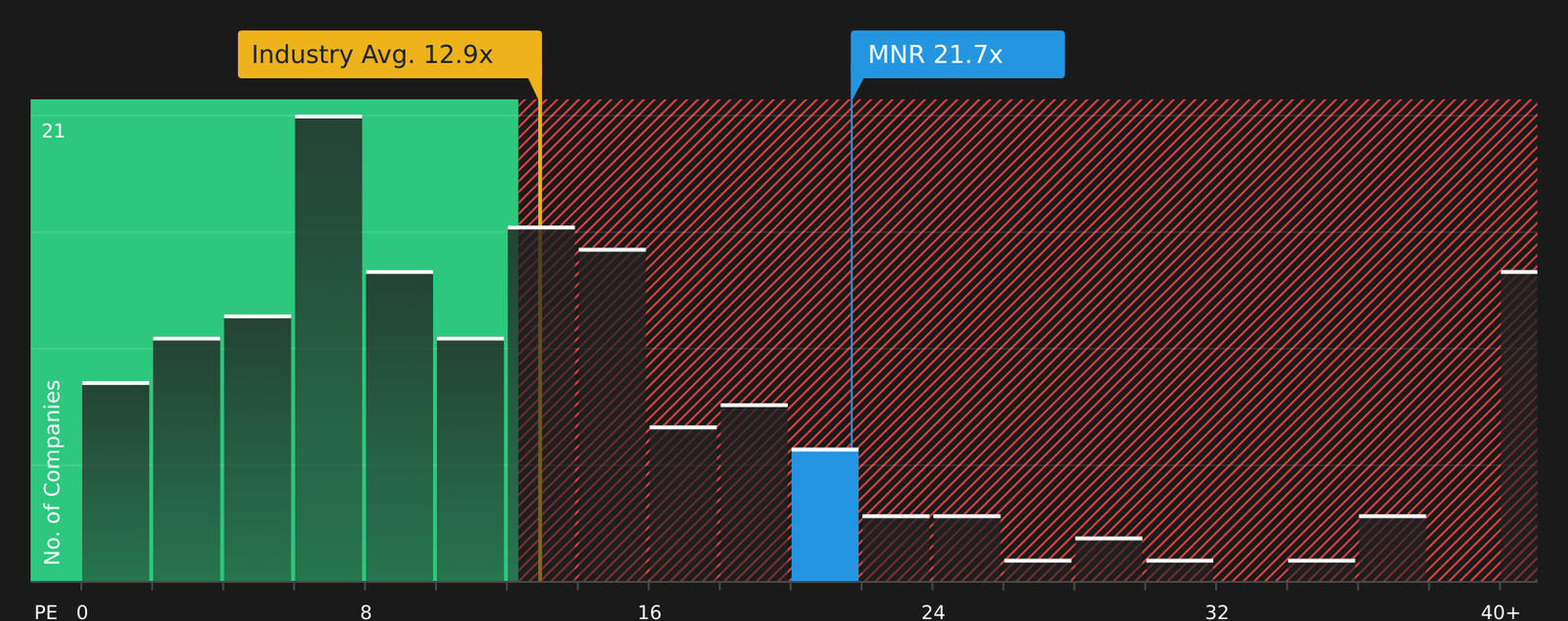
Mach Natural Resources (MNR) has surged 15.2% year-to-date, but current market valuations suggest the stock may be overextended following its updated 2026 outlook. Investors are now questioning whether the company’s recent price appreciation leaves any room for further growth or if the current entry point is simply too expensive.
Evaluating the Price-to-Earnings (P/E) Premium
For income-focused energy investors, the P/E ratio is a critical benchmark. Currently, Mach Natural Resources trades at a P/E of 23.7x. This figure sits significantly higher than both the broader Oil and Gas industry average of 13.1x and its direct peer group average of 17.5x. This premium multiple indicates that the market is pricing MNR at a notable markup compared to other energy producers.
The Gap Between Market Price and Fair Value
Valuation models suggest a fair P/E ratio for Mach Natural Resources of approximately 14.8x, aligning more closely with sector norms. Even when accounting for the company’s strategic shift toward oil-weighted projects and its updated 2026 outlook, the current market price remains disconnected from this model-driven valuation. This discrepancy implies that investors are currently paying a premium for existing earnings that may not be supported by industry standards.
Assessing Future Growth and Cash Flow
The core challenge for Mach Natural Resources moving forward is justifying this valuation premium. The investment thesis now hinges on the company’s ability to execute its projects and maintain the high-quality cash flow necessary to sustain such elevated multiples. Without a clear improvement in earnings metrics to close the gap, the stock remains sensitive to whether it can continue to outperform its peers in profitability per dollar earned.
Ultimately, the decision to invest in MNR depends on whether market participants believe the company can deliver the growth trajectory required to validate its current price. While the stock has seen momentum, the fundamental data suggests that the market has already factored in significant expectations, leaving little margin for error.