

Rio Tinto Group (LSE:RIO) shares have surged 88.9% over the past three years, but current market valuations present a conflicting picture as Discounted Cash Flow (DCF) models suggest the stock is overvalued while earnings multiples indicate it remains attractively priced.
The DCF Perspective: A Premium Valuation
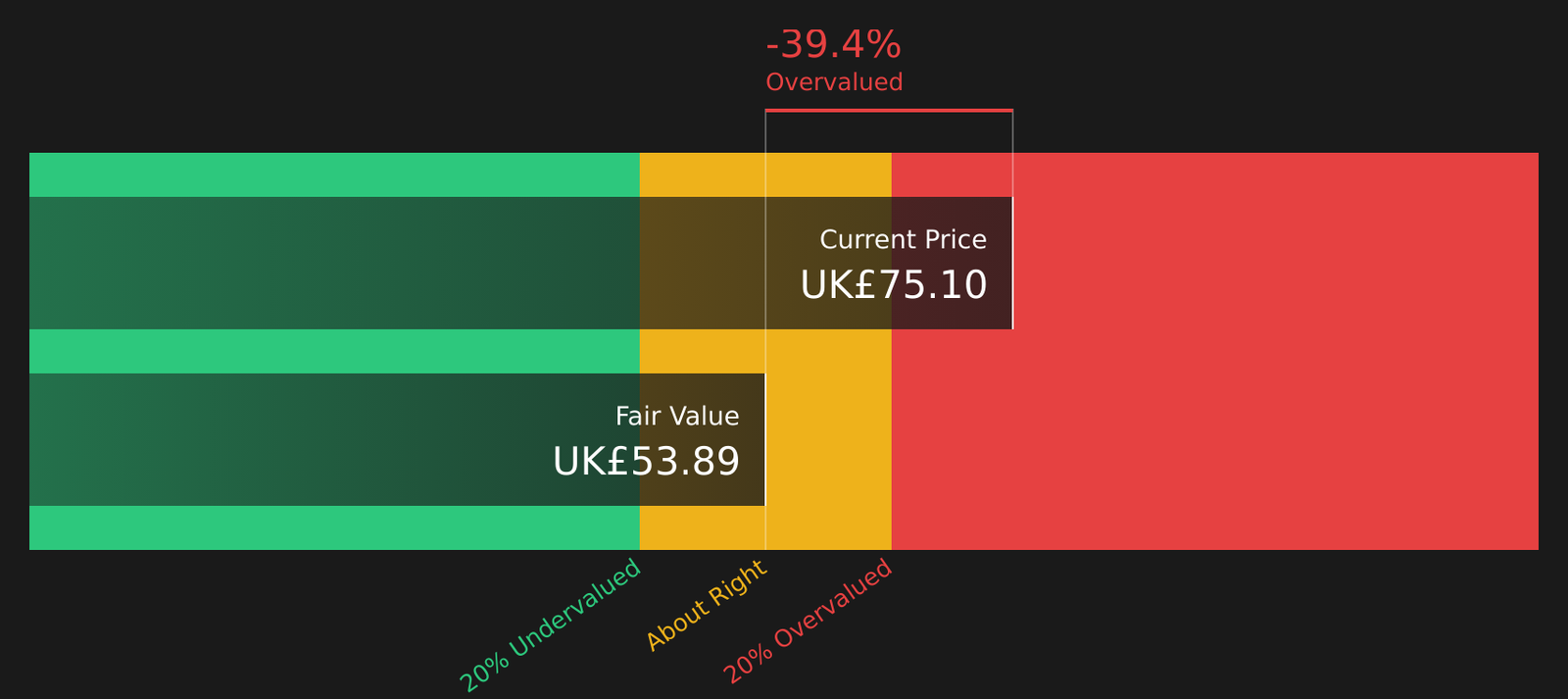
The Discounted Cash Flow (DCF) approach evaluates the present value of the company’s expected future cash flows. Using the latest twelve-month free cash flow of approximately US$7.4 billion—and accounting for near-term growth projections followed by more modest long-term stabilization—the model calculates an intrinsic value of £53.89 per share.
When measured against the current share price, this model indicates that Rio Tinto is trading at a 39.4% premium. Despite a recent boost in earnings from copper operations and stronger free cash flow, the market price continues to sit above the valuation suggested by this cash-flow-based metric.
Earnings Multiples: Signaling Undervaluation
Conversely, when examining P/E ratios, the narrative shifts. Rio Tinto currently trades at a P/E of approximately 13.6x. This figure sits below the Metals and Mining industry average of 14.5x and significantly trails the broader peer group average of 31.2x.
When applying a tailored fair P/E estimate of 19.2x—which adjusts for the company’s specific earnings profile, size, and sector-related risks—Rio Tinto appears to be trading at a discount. Even with the company’s recent strong performance in copper and other commodity segments, the current market price implies a lower valuation than this customized benchmark suggests.
Market Sentiment and Future Outlook
The divergence between DCF results and earnings multiples highlights the ongoing debate among investors regarding Rio Tinto’s future. The gap reflects two distinct market perspectives: one side remains concerned about the timing of cash flows, capital-intensive projects, and funding requirements, while the other side focuses on the premium investors are willing to pay for earnings tied to commodity cycles.
Ultimately, the market remains divided. One group of investors points to the long-term upside potential of global electrification, while another remains cautious, citing inherent risks in iron ore reliance and rising operational costs. The core challenge for shareholders moving forward is determining whether the cash flows from major upcoming projects will prove robust enough to justify the current market entry point.