
Binance, the leading cryptocurrency exchange with over 300 million registered users, introduced a groundbreaking platform on Thursday that allows AI agents to analyze market conditions and execute trades on behalf of users, marking a significant shift towards autonomous AI in financial management.
Introducing Agent OS
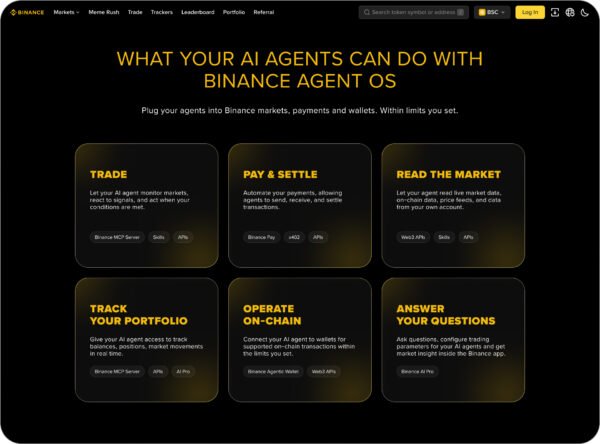
Named Agent OS, this innovative platform provides developers with the ability to link AI applications and agents to Binance’s financial infrastructure. It integrates existing tools and services such as Binance APIs, Binance Wallet Agentic Hub, transaction verification APIs, and the newly added support for its Model Context Protocol (MCP). Furthermore, it is compatible with advanced tools including OpenAI’s ChatGPT and Codex, as well as Anthropic’s Claude Code, empowering users to authorize agents to access market data, view account details, and execute trades autonomously.
User Control and Responsibility
As the landscape of AI evolves from simple chatbots to proactive agents capable of executing trades, Binance emphasizes that a significant portion of the responsibility for monitoring these agents lies with the users. They must decide what permissions agents will have regarding access to market data and trading capabilities, and establish limits on their actions.
“Rather than allowing complete autonomy, we empower users with detailed access control over what actions can be performed by the agent,” stated Jeff Li, Binance’s vice president of product, in an interview. “This control is provided at the account level to safeguard users’ funds.”
Subaccounts for Enhanced Security
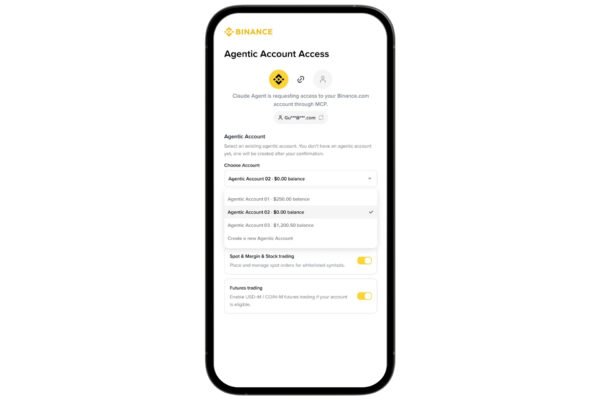
To achieve this, Binance utilizes dedicated “subaccounts,” which users can assign to agents and tailor for specific functions, such as spot or futures trading. Withdrawals from these subaccounts are restricted by default, creating a secure environment around the agent’s activities, according to Li in his comments to TechCrunch.
Users also have the option to require AI agents to seek approval for each order, or they can enable autonomous trading once the necessary permissions are set. Binance does not enforce a separate trading limit on how much an agent can trade or potentially lose; instead, the amount transferred into the subaccount acts as the cap.
Monitoring and Security Measures
When asked if Binance can track the reasoning behind an agent’s trading decisions, Li clarified that such reasoning occurs outside of Binance’s systems, either on the user’s device or within their chosen AI application. “We cannot see the reasoning behind the user’s actions,” he explained.
Consequently, while Binance can observe the trading activities of an agent, it has limited insight into whether decisions are affected by erroneous information or manipulative tactics.
Li reiterated the importance of the subaccount as a primary defense mechanism, particularly when queried about potential manipulations such as prompt-injection attacks. Binance asserts that existing security, risk control, and anti-money laundering protocols for subaccount APIs will also apply to Agent OS upon its release.
Expanding the AI Use Cases
Initially focusing on trading, Binance aims for agents to also conduct market monitoring, perform research and risk assessments, respond to market signals, and autonomously execute strategies like arbitrage.
Agent OS is designed to facilitate connections between agents and payment systems, as well as on-chain activities. With Binance’s x402 integration, agents can manage payments and settlements, while the Agentic Wallet enables interaction with tokens and decentralized finance protocols.
Contrary to exchange trading, where Binance does not set specific limits on how much an agent can trade or lose within its subaccount, transactions through the Agentic Wallet are subject to daily limits established by Binance. Regular swaps are capped at $50,000 per day, DeFi operations have a default limit of $100,000 daily, and x402 payments are restricted to $20 daily, as reported by the company.
Li described Agent OS as Binance’s “first step” toward offering developers a platform to create AI-driven applications capable of operating across both cryptocurrency and traditional markets.
Binance is not the only player leveraging its infrastructure for AI agents; competing cryptocurrency exchanges are pursuing similar initiatives, utilizing MCP and other developer tools to grant AI applications direct access to market data and trading functionalities.
In March, Kraken launched an open-source command-line tool equipped with a built-in MCP server, enabling AI agents to carry out trades, including spot and futures transactions. Following suit, Coinbase introduced Coinbase for Agents in June, allowing AI agents to directly interact with users’ accounts for trading, payments, and other financial functions within user-defined parameters. Similarly, OKX enabled agentic trading earlier this year through the release of an open-source MCP toolkit.