

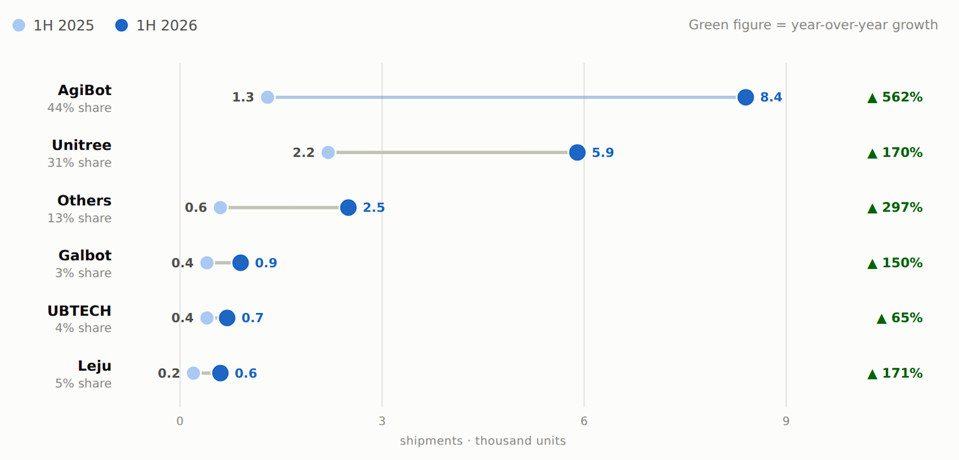
Global humanoid robot shipments skyrocketed by 272% year-over-year in the first half of 2026, hitting 19,100 units, according to a report from Smart Analytics Global. With total volume projected to reach 60,000 units by year-end and half a million by 2030, the industry is accelerating rapidly—but the current surge is almost entirely fueled by Chinese vendors.
The Numbers Behind the Chinese Surge
The data reveals a stark market imbalance: Chinese vendors were responsible for over 97% of all humanoid robots shipped globally in H1 2026, while domestic demand within China accounted for 85% of the total market. For perspective, last year’s total shipments of 13,317 units have already been eclipsed in just six months.
Leading the pack is Shanghai-based AgiBot, which secured 44% of the global market with 8,400 units, marking a 562% increase. Unitree follows with 5,900 units, representing a 31% market share. Combined, these two firms control three-quarters of the global humanoid robot population.
From Viral Demos to Real-World Utility
Beyond the volume, the nature of these deployments is shifting. Linda Sui, founder of Smart Analytics Global, notes that industrial and commercial applications now account for over 70% of shipments, up from 50% last year. While Unitree continues to dominate research labs and viral social media with its compact G1 model, AgiBot has diversified with a full suite of bipedal and wheeled robots designed for factory and logistics environments.
The Impact of US Regulatory Barriers
This rapid growth coincides with an aggressive shift in US policy. In late July, the Federal Communications Commission (FCC) moved to block new imports of foreign-made humanoid and quadruped robots, citing concerns over cybersecurity and national security. By specifically naming companies like Unitree and AgiBot, the US is attempting to prevent foreign-manufactured hardware—rife with sensors and network connectivity—from infiltrating critical infrastructure and homes.
Why the “Sales Gap” Isn’t an “Engineering Gap”
While the statistics may look grim for Western firms, the current market landscape is a result of divergent strategies rather than a lack of capability. American leaders such as Tesla, Figure, 1X, Agility Robotics, and Boston Dynamics are prioritizing technological maturity over raw output.
Scaling too early carries significant risks: deploying unreliable hardware can destroy brand equity and waste precious capital. US and European companies are opting for a “Goldilocks” approach—waiting for the precise moment when robot capabilities align with guaranteed economic viability for their customers.
The Long-Term Outlook
While China’s head start in deployment data provides a competitive edge, the race is far from finished. The FCC ban provides domestic manufacturers with a protective window to refine their technology. For now, the global market is witnessing a tale of two philosophies: China is winning the race for volume, while Western developers are betting that quality and reliability will win the race for long-term dominance.