

Compass (COMP) has delivered an impressive 49.8% return over the past year, but current valuation metrics suggest the stock may now be trading at a significant premium, leaving investors to question if the rally has room to run.
Evaluating the Price-to-Earnings Disconnect
The core of the current debate centers on whether the recent positive earnings reports and strong historical performance are already fully baked into the share price. A primary tool for assessing this sentiment is the Price-to-Earnings (P/E) ratio, which reflects what the market is willing to pay for every dollar of the company’s earnings.
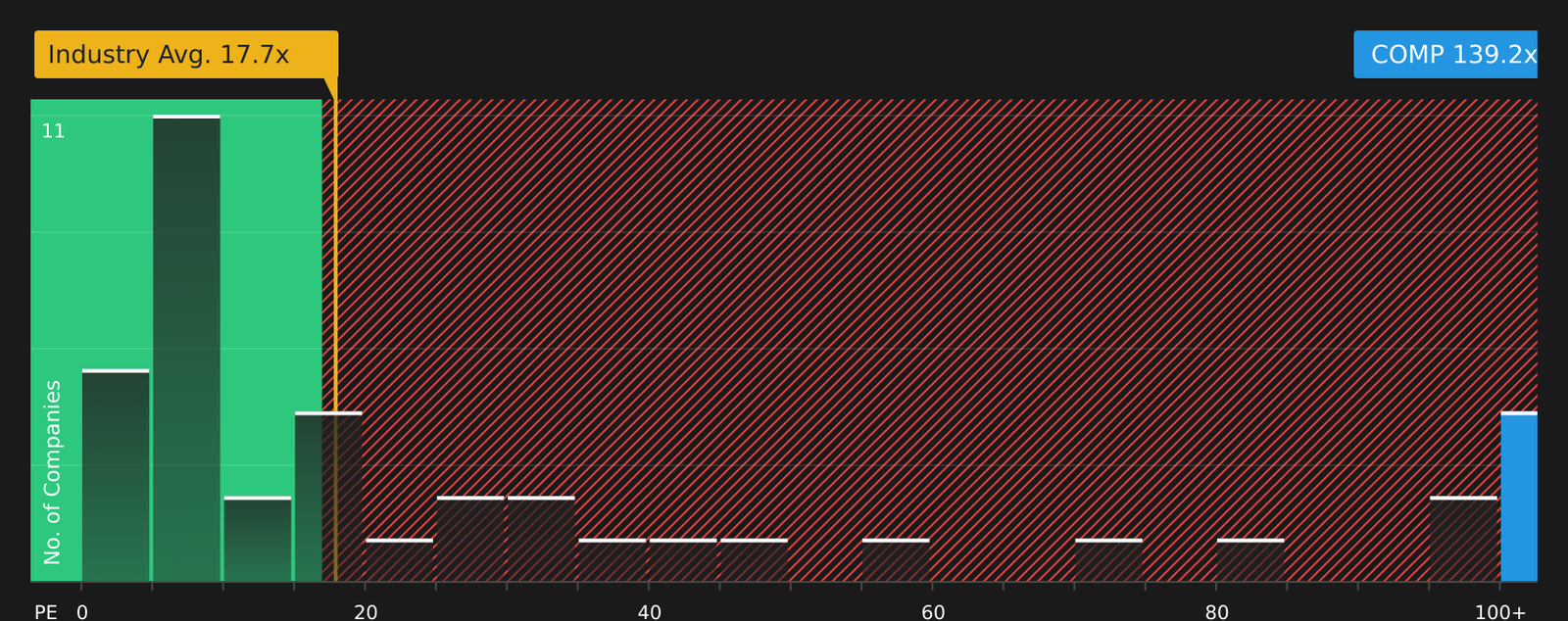
Currently, Compass trades at a P/E ratio of approximately 139.2x. This figure sits substantially higher than the broader real estate industry average of 17.7x and dwarfs the peer group average of 92.1x.
The Fair Value Gap
When applying a valuation model that accounts for Compass’s specific growth profile, profit margins, size, and inherent market risks, a “fair” P/E ratio for the company is estimated to be around 43.3x. While this model heavily penalizes the stock for its risk profile, the wide gap between the current multiple and this fair value acts as a warning flag, indicating that the stock is priced aggressively relative to its actual earnings.
Market Optimism vs. Execution Risk
Despite a strong Q2 earnings beat and optimistic forward-looking guidance, the market appears to have priced in a high degree of confidence. The current valuation suggests that investors are paying a premium for future growth, making the stock appear overvalued when compared to both industry benchmarks and tailored fair value projections.
Future Outlook and Sustainability
The sustainability of this elevated multiple depends entirely on Compass’s ability to consistently deliver on earnings growth and margin expansion. If housing market conditions shift or if there is a lapse in operational execution, the valuation may face pressure to revert toward the levels seen among its peers.
For investors looking deeper into the numbers, understanding the specific growth paths required to justify the current price is essential. Whether the market is being too cautious or too optimistic remains the central puzzle for those holding or considering a position in COMP.